June 28, 2026
healthcare-itfhirhl7interoperabilityThe Basics of Healthcare Interoperability: HL7 & FHIR
A plain-language introduction to how hospitals and software systems share patient data, and the standards that make it possible.
On this page
The Basics of Healthcare Interoperability: HL7 & FHIR
If you've ever moved to a new city and had to explain your full medical history to a new doctor from scratch, you've felt the problem this post is about.
What is healthcare interoperability?
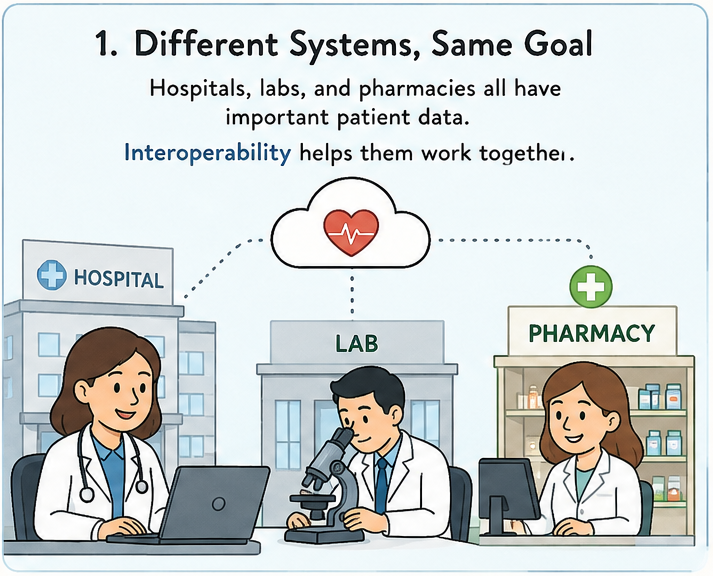
Healthcare interoperability means that different software systems (a hospital's patient record system, a lab, a pharmacy, a specialist's clinic) can share and understand each other's data.
Without it, a blood test result sitting in one system might never reach your doctor's screen in another. Staff end up faxing documents, retyping data by hand, or making phone calls just to move information that should flow automatically.
Interoperability solves that. It's the difference between systems that can talk to each other and systems that exist in isolation.
What is HL7?
HL7 stands for Health Level 7. It's both an organization and a set of standards, and it has been defining how healthcare data gets structured and exchanged since the 1980s.
The most widely used version is HL7 v2, a messaging standard that hospitals have relied on for decades. When a patient is admitted, when a lab order is placed, or when a result comes back, HL7 v2 messages carry that information between systems.
A simple HL7 v2 message
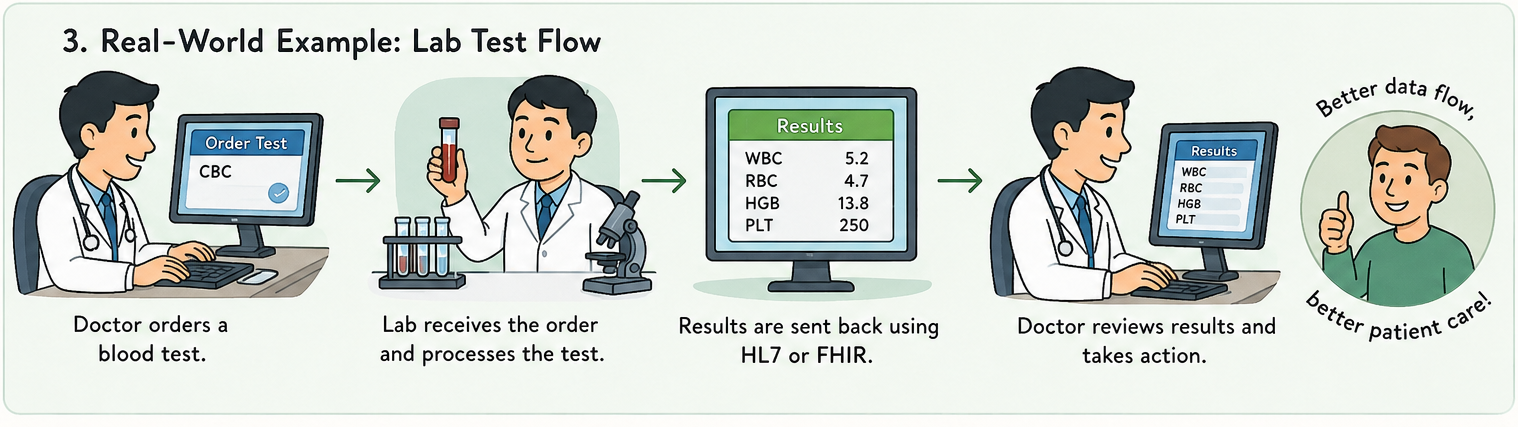
HL7 v2 messages look a bit cryptic at first, but the structure is straightforward: each line is a segment, and fields are separated by pipe characters (|).
MSH|^~\&|LAB|HOSPITAL|EHR|CLINIC|20240415120000||ORU^R01|MSG001|P|2.5
PID|1||123456^^^HOSPITAL^MR||Roe^Richard||19900101|M
OBX|1|NM|2345-7^Glucose^LN||5.4|mmol/L|3.9-6.1||||F
In plain English, this message says:
- MSH: this is a lab result message sent from the LAB system to the EHR system
- PID: the patient is Richard Roe, born 1990-01-01
- OBX: the glucose level is 5.4 mmol/L, which is within the normal range (3.9 to 6.1)
It's compact and efficient, which is exactly why it stuck around. But it's not easy for humans to read.
What is FHIR?
FHIR (pronounced "fire") stands for Fast Healthcare Interoperability Resources. It's a modern standard from the same HL7 organization, just with a newer approach.
Where HL7 v2 sends flat text messages between systems, FHIR works like a web API. Data is represented as resources (Patient, Observation, Medication, etc.) in standard JSON or XML, and you access them over HTTP, the same way any web app communicates.
A simple FHIR Patient resource
{
  "resourceType": "Patient",
  "id": "123456",
  "name": [
    {
      "family": "Roe",
      "given": ["Richard"]
    }
  ],
  "birthDate": "1990-01-01",
  "gender": "male"
}
This is just JSON. Any developer who has built a web app can read it. That's the point.
A real-world example: a lab test from start to finish
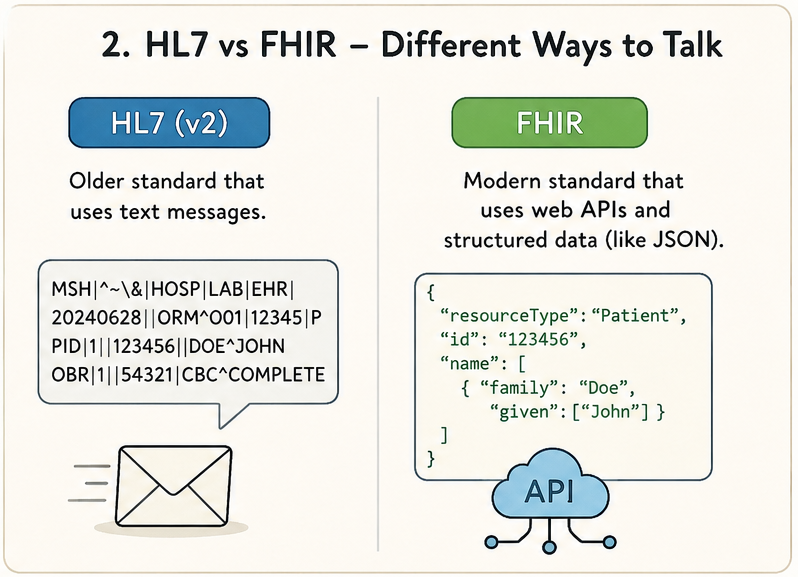
Here's how a blood test might travel through a healthcare system using these standards:
- Doctor orders the test. The EHR (Electronic Health Record) sends an HL7 v2
ORM(Order) message to the lab system. - Lab runs the test. The blood sample is processed.
- Lab sends the result back. The lab system sends an HL7 v2
ORU(Observation Result) message to the EHR. - Doctor sees the result. The EHR displays the glucose level, flagged if it's out of range.
In a FHIR-based system, the same flow would happen through REST API calls: the EHR would POST a ServiceRequest resource to order the test, and the lab would POST back an Observation resource with the result.
HL7 v2 vs FHIR: plain language comparison
| HL7 v2 | FHIR | |
|---|---|---|
| Format | Pipe-delimited text | JSON / XML |
| Style | Messages pushed between systems | REST API calls |
| Readability | Hard for humans | Easy for developers |
| Age | 1980s to now | 2014 to now |
| Adoption | Everywhere (legacy) | Growing fast |
| Mobile / web friendly | No | Yes |
HL7 v2 is like a fax machine: it works, it's everywhere, and hospitals built entire workflows around it. FHIR is like email: flexible, developer-friendly, and built for how modern software actually works.
Why FHIR is growing, and why HL7 v2 isn't going away
FHIR is gaining ground for a few key reasons:
- Developers can build with it quickly. Standard HTTP and JSON means any web or mobile developer can work with healthcare data without learning a specialized format.
- Regulators are pushing it. In the US, for example, the government now requires certain health systems to expose patient data via FHIR APIs.
- It powers patient-facing apps. Apple Health and Google Health both use FHIR to let patients access their own records.
But HL7 v2 isn't going anywhere soon. Hospitals have been running it for 30+ years. Replacing infrastructure that deep is expensive, and the existing systems work well enough. Most real-world healthcare IT environments run both: FHIR at the edges talking to new apps and APIs, and HL7 v2 keeping the internal machinery running.
Wrapping up
Healthcare interoperability is about making sure data follows the patient, not the other way around. HL7 v2 laid the groundwork and still powers the backbone of most hospital systems today. FHIR is where healthcare IT is heading: open, web-based, and much easier for developers.
If you're working in healthcare software, you'll need to understand both.